
Product guide • Setup notes • First-flight advice
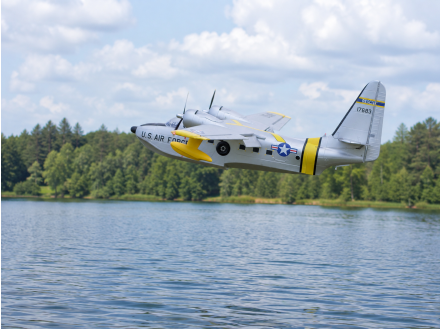
The Avios Albatross HU-16 USAF Search & Rescue RC Flying Boat PNF 1620mm combines a purpose-built amphibious hull, twin-motor power, flaps, navigation lights, a water rudder and reversing ESCs in a distinctive USAF Search & Rescue finish. This guide covers the key setup points, battery choices, water handling and first-flight preparation.
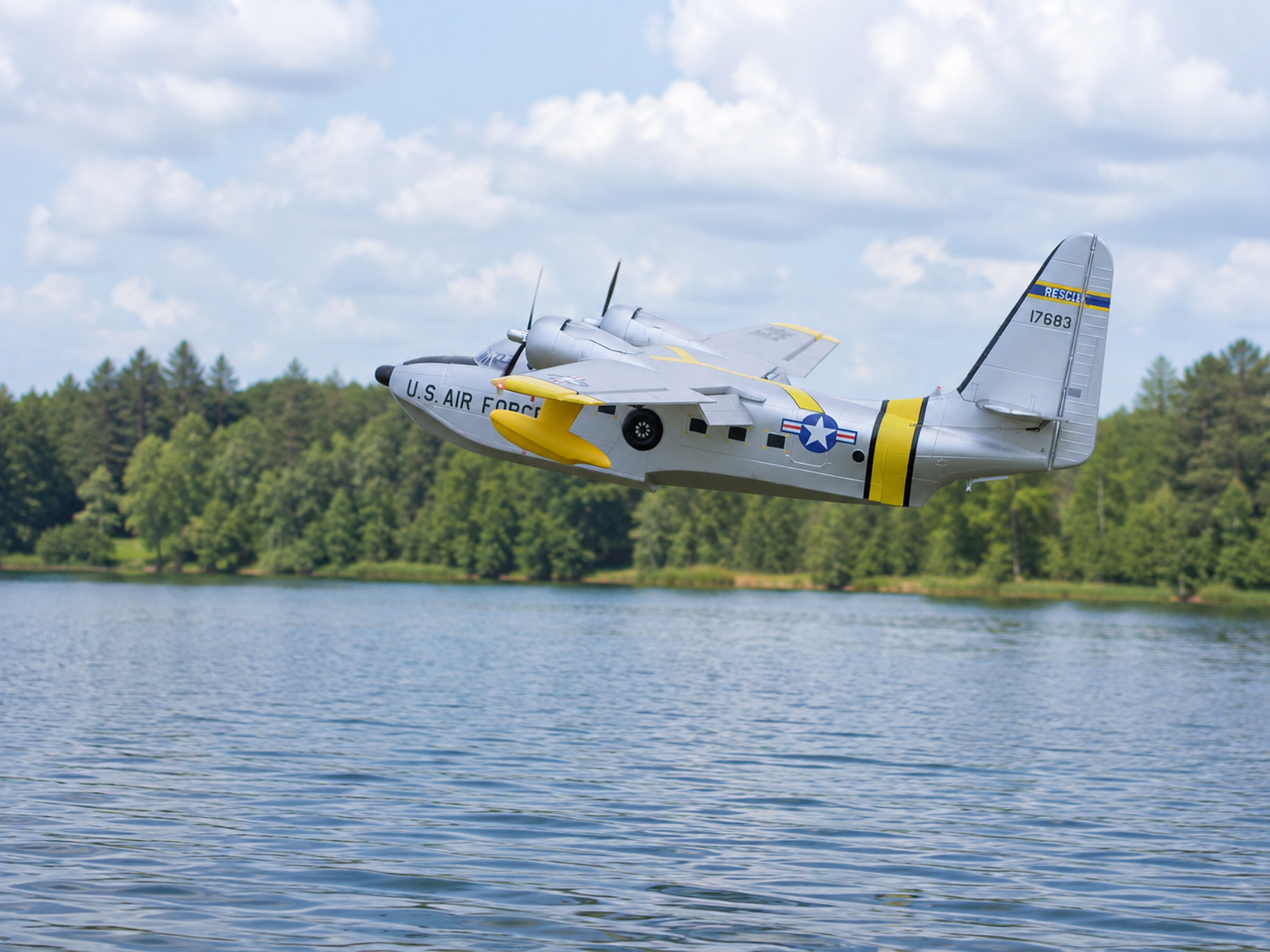
Few RC aircraft can make an ordinary low pass look as convincing as a twin-engine flying boat. The Avios Albatross HU-16 has the broad hull, high wing, tip floats and purposeful stance of the full-size Grumman HU-16, but its attraction is not limited to scale appearance. It can operate from water or smooth short grass, it has working flaps and navigation lights, and its reversing ESCs add a useful layer of control after touchdown.
This is a Plug-N-Fly model for pilots who want something more involving than a conventional foam sport plane but do not want a long build. Most of the airframe and power system are installed; the important work is choosing the receiver and battery, programming the radio correctly and confirming the setup before the first launch.
Avios Albatross HU-16 at a glance
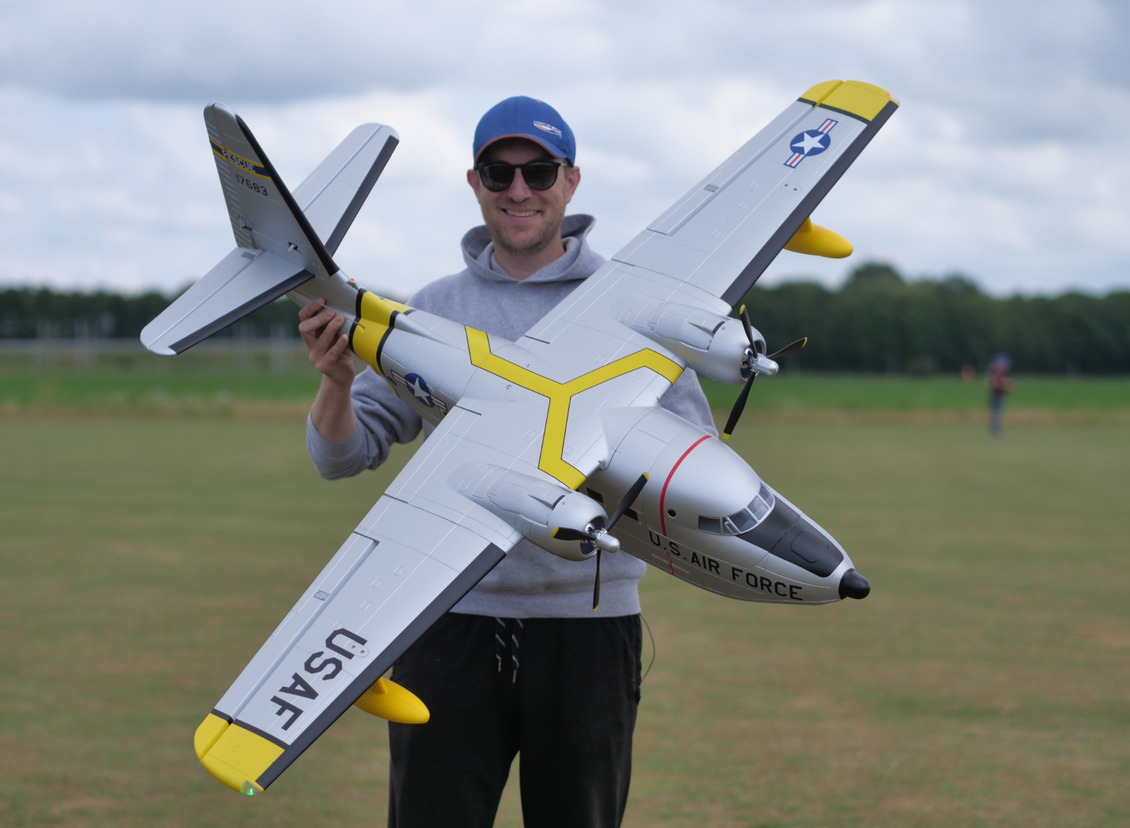
| Wingspan | 1620mm (63.7in) |
|---|---|
| Length | 1210mm (47.6in) |
| Flying weight | Approximately 2170g without flight battery; 2570g with battery |
| Motors | 2 x AeroStar 3536-850KV brushless outrunners |
| ESCs | 2 x Turnigy AeroStar 30A RVS reversing ESCs |
| Propellers | 2 × 10x6 three-blade scale propellers, one CW and one CCW (same specification as Albatross V2) |
| Servos | 7 x 9g servos |
| Recommended battery | 4S 3300-4000mAh, or 3S 5000mAh for a more relaxed scale setup |
| Recommended CG | 65-70mm behind the wing leading edge, measured at the center of the wing |
| Pilot level | Intermediate; not recommended as a first RC airplane |
USAF Search & Rescue livery and scale character
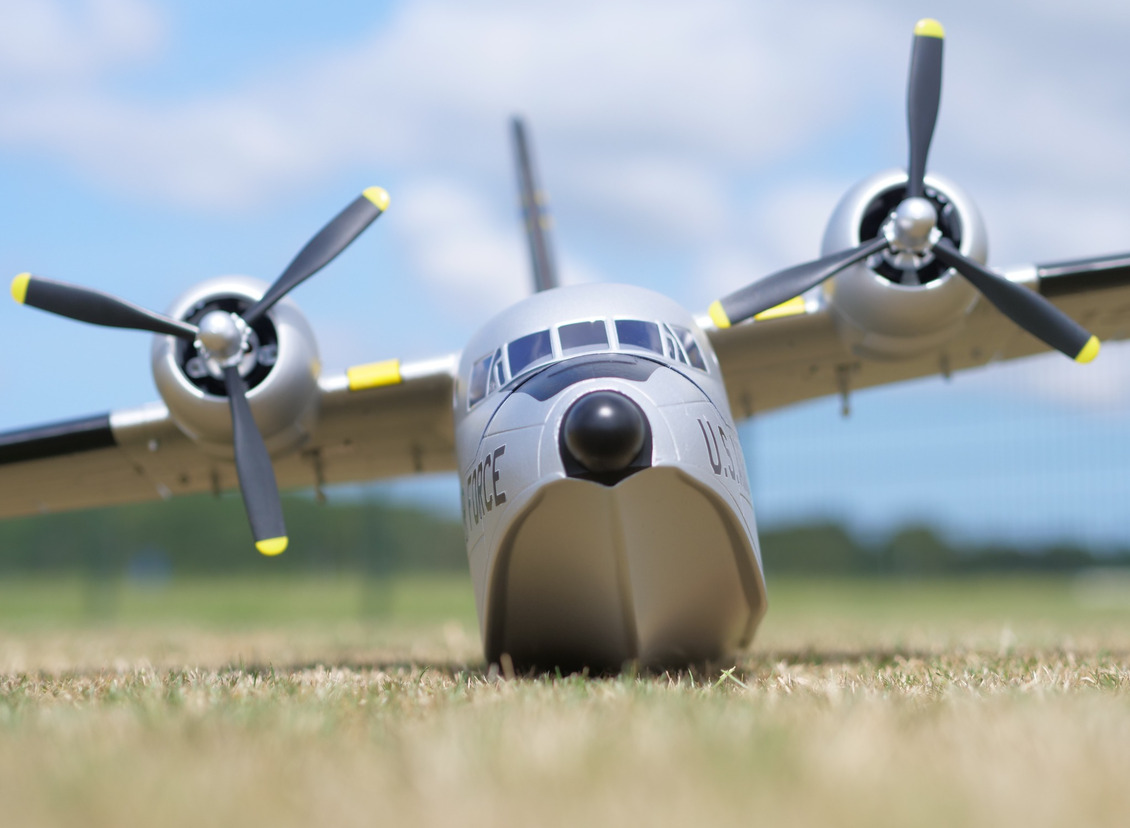
The defining visual feature of this Albatross is its USAF Search & Rescue livery. The silver airframe, yellow high-visibility panels and military rescue markings suit the HU-16's classic amphibious shape and give the model a strong scale presence on the water and in the air.
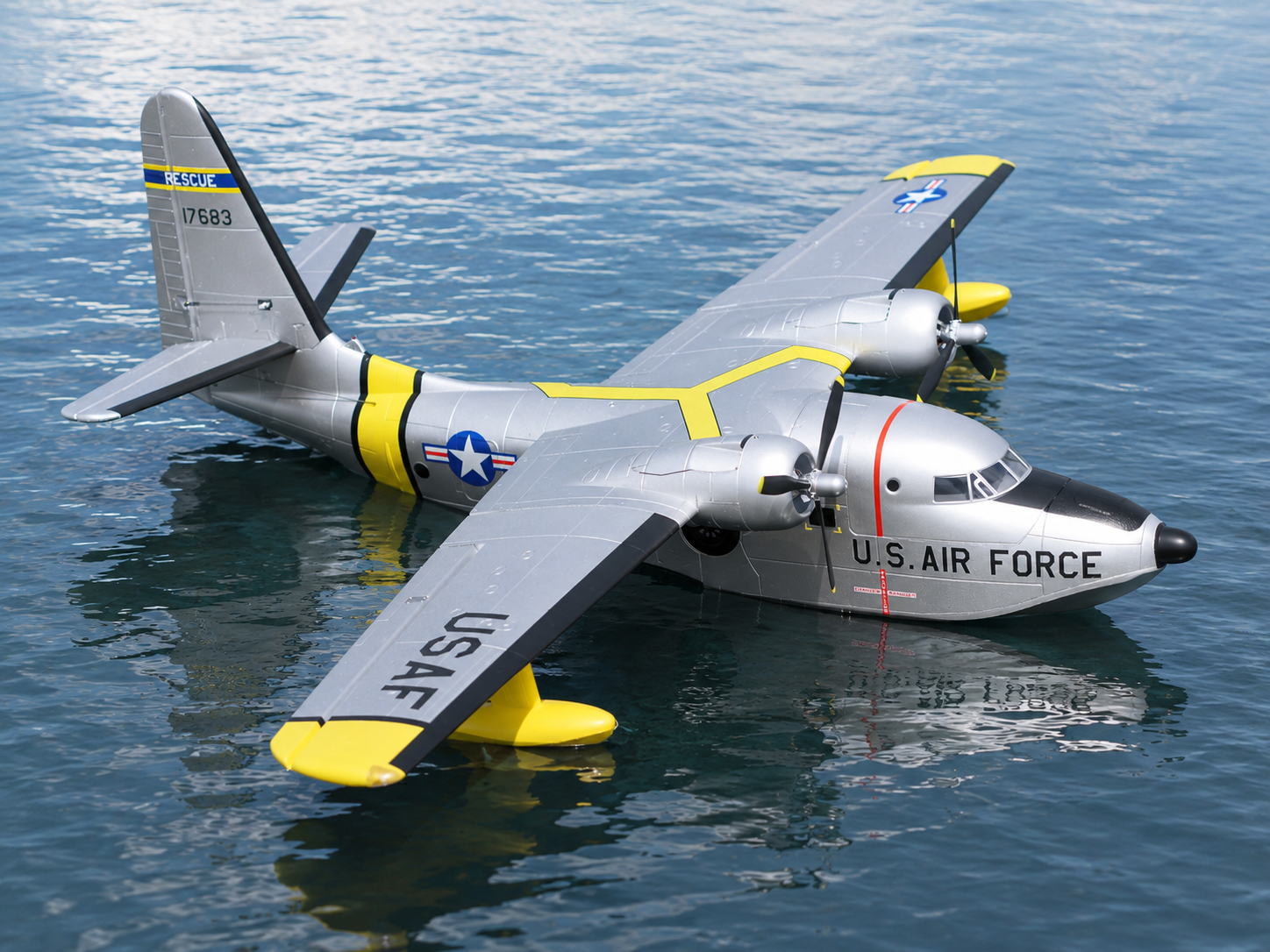
The Albatross HU-16 uses a matched clockwise and counter-clockwise three-blade propeller pair. The blades must be fitted to the correct motors so that, when viewed from the front, both propellers rotate inward toward the fuselage. Correct installation helps the aircraft track cleanly under power.
How does the Avios Albatross HU-16 fly?
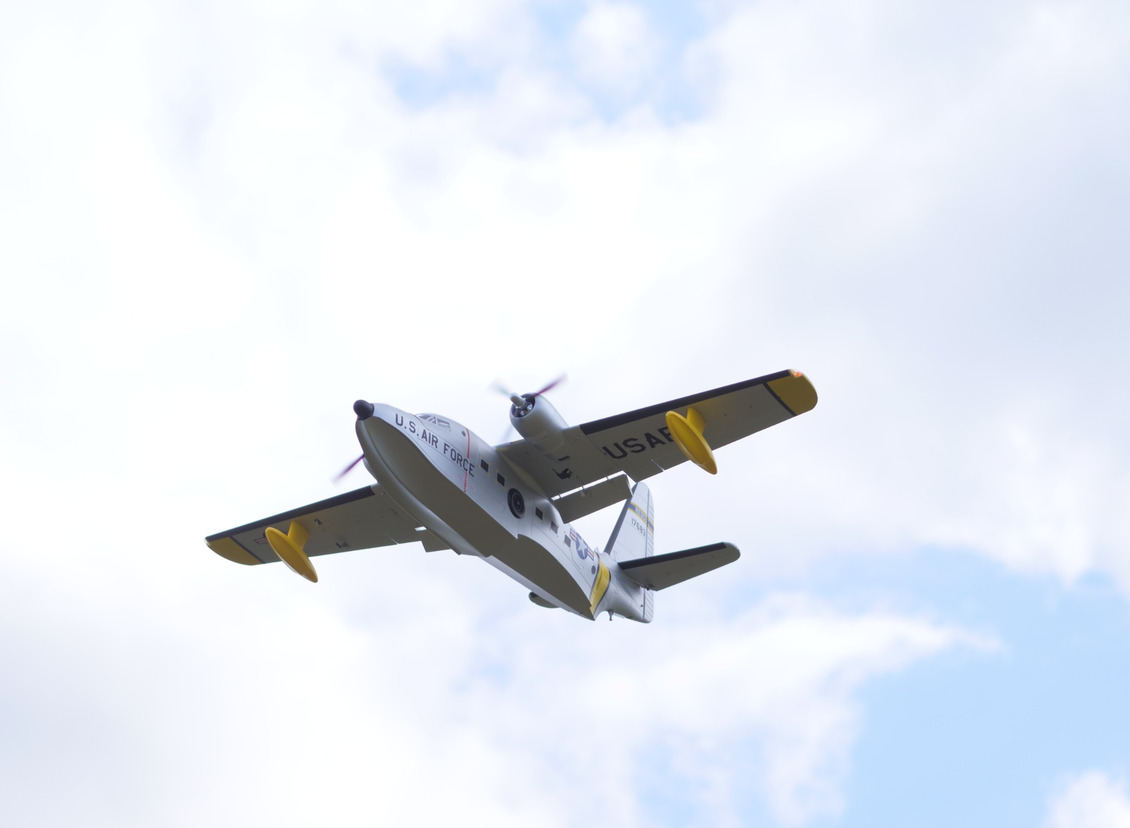
In the air, the Albatross is best treated as a scale twin rather than a high-alpha trainer. The high wing and generous span give it a settled, confidence-building feel once it is moving, while the two motors provide enough authority for clean climb-outs and large, smooth manoeuvres. It looks most convincing at a moderate throttle setting, flying long circuits, sweeping banked turns and low passes.
The flaps make it easier to manage approach speed, but they do not remove the need for good energy management. Hold a little power through the descent, keep the turn onto final coordinated and avoid forcing the aircraft around with excess rudder while it is slow. On touchdown, aim for a slightly nose-high attitude so the hull step contacts first on water.
Is the Avios Albatross HU-16 suitable for a beginner?
It should not be a pilot's first RC airplane. The model can be stable and forgiving, but a twin-motor seaplane adds several jobs that a first-time pilot should not have to learn at once: flap management, water or grass technique, multiple ESCs, reverse programming and the inertia of a model weighing around 2.57kg with its battery.
A pilot who can confidently take off, fly a rectangular circuit and land a four-channel trainer without assistance should find the transition reasonable. Previous flap experience is useful, and a few flights from smooth grass before the first water session can be a sensible way to learn the model's speed range.
3S or 4S: which battery should you choose?
Both battery options in the setup guide are valid, but they create different versions of the same aircraft. A 4S 3300-4000mAh pack gives the stronger take-off acceleration and climb margin most pilots will want for grass, less-than-perfect water or a little extra wind. It is the more versatile starting point.
A 3S 5000mAh pack suits relaxed, scale-oriented flying. Throttle response is softer and the aircraft encourages smooth circuits rather than repeated full-power climbs. The larger capacity helps compensate for the lower voltage, although capacity alone does not guarantee a longer flight because weight, throttle use, wind and repeated water taxiing all affect consumption.
Battery setup matters more than a decorative photo here. Position the pack so the aircraft balances at the specified CG, secure it so it cannot move, then set the flight timer from real capacity used after the first few flights.
For the maiden flight, set a conservative timer rather than relying on an advertised duration. After landing, record the capacity returned to the pack and adjust the timer so that a healthy reserve remains. This method is more useful than quoting one flight time for every battery and flying style.
Where should the center of gravity be?
The recommended CG is 65-70mm behind the leading edge, measured at the center of the wing. Start near the forward end of that range for the maiden. A slightly nose-heavy Albatross may need a touch more elevator in the flare, but it will normally feel more predictable while you establish the correct flap and approach settings.
Do not judge the CG with the model empty. Install the flight battery, secure it exactly as it will be flown and check both wings at the same measurement point. An aft CG can make the pitch response too sensitive and reduce the margin when the model is slow. That is one reason reports of a sudden wing drop are often better solved by checking balance and turn coordination than by adding more control throw.
Do you need six channels or seven?
A condensed six-channel installation may be possible with Y-leads and transmitter mixing, depending on the radio system and which functions are combined. However, a seven-channel or greater receiver is the practical recommendation if you want full use of the reversing ESCs without compromising the setup.
More channels also make the installation easier to understand and troubleshoot. They give you cleaner control of throttle functions, flaps and lights, and they reduce the temptation to build a complicated chain of adapters simply to save one receiver output.
Reverse thrust, differential thrust and the water rudder explained
These three features solve different problems, and they are often confused.
- The water rudder is the primary steering control while taxiing forward at low speed.
- Differential thrust adds a small motor-speed difference with rudder input to tighten turns. If used, begin conservatively; the manual guidance is around 15%.
- Reverse thrust helps slow the model after landing, back away from a bank or improve positioning on the water. It is not intended to be selected in flight.
Program reverse on a deliberate, guarded control and confirm that both ESCs enter reverse together. With the model restrained and the propeller area completely clear, test forward, neutral and reverse at low power. Also test the radio failsafe so that a signal loss cannot command either forward or reverse power.
Can it take off from grass as well as water?
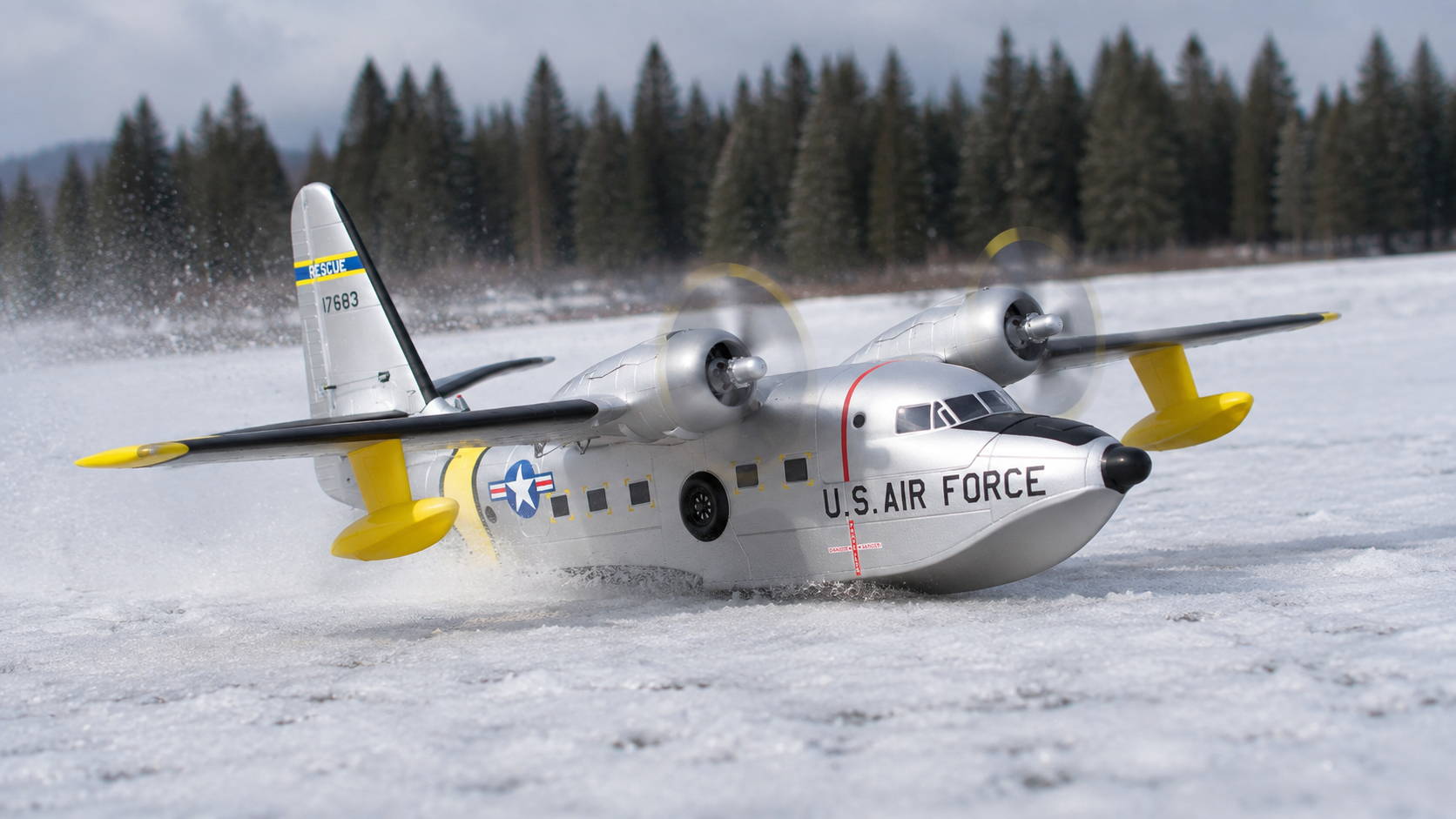
Yes. The Albatross can slide from smooth, short grass on its hull, giving pilots without safe water access a practical way to fly it. Grass length and surface quality matter: long, wet or uneven grass creates drag, increases the take-off run and can damage the hull finish. A firm, closely cut strip is the right environment.
On grass, hold a small amount of up elevator and feed in power smoothly. Let the model accelerate instead of pulling it abruptly into the air. Once it unsticks, relax the elevator and establish a positive climb. After each session, inspect the hull step and underside for cuts, dents or lifted tape.
Is the Avios Albatross HU-16 waterproof?
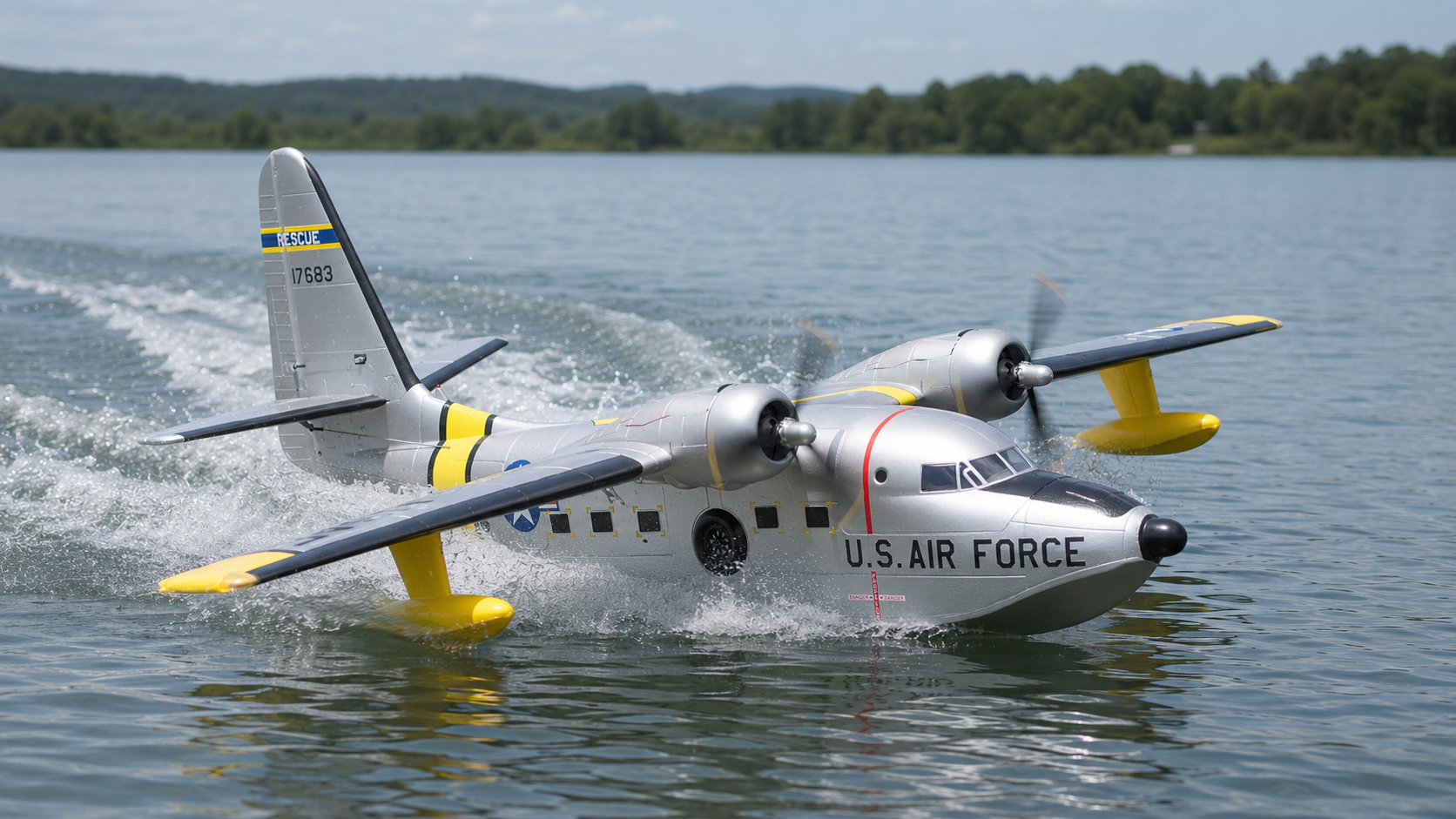
No RC seaplane should be treated as a sealed boat. The Albatross is designed for water operation and uses splash-resistant components, but water-resistant does not mean waterproof. Check the hatch seal and hull before every water flight, keep spray exposure sensible and open the battery compartment after the session so trapped moisture can escape.
Fresh water is strongly preferable. Salt water attacks connectors, bearings, motor hardware and exposed metal quickly. If salt-water operation cannot be avoided, use appropriate corrosion protection and clean and dry the model immediately afterwards. Never leave a damp battery or receiver sealed inside the fuselage.
First-flight setup: the numbers that matter
The following values come from the setup guide. Measure each control at the widest practical point and confirm direction before adding any exponential to personal taste.
| Elevator | 8mm low rate / 14mm high rate |
|---|---|
| Rudder | 10mm low rate / 20mm high rate |
| Aileron | 15mm low rate / 24mm high rate |
| Flaps | Approximately 25mm (25 degrees) / 45mm (45 degrees) |
| CG | 65-70mm behind the leading edge at wing center |
Use low rates for the maiden and test the first flap position at a safe height. If your radio supports flight modes, keep the maiden programming simple: normal flight, take-off flap and landing flap. Any elevator compensation should be added only after observing what this particular model does when the flaps extend.
Before connecting the flight battery
- Confirm the receiver is secure and every plug is fully seated.
- Check the battery can achieve a 65-70mm CG and cannot move in flight.
- Verify the 10x6 CW and CCW propellers are on the correct sides and firmly fitted.
- Switch on the transmitter, select the correct model memory and set forward throttle to idle.
After connecting the flight battery
- Check aileron, elevator, rudder, flap and water-rudder direction.
- At very low power, confirm both propellers rotate inward toward the fuselage.
- Test reverse only with the model restrained and all people clear of the propellers.
- Perform a radio range check and confirm the motor failsafe.
Watch the Avios Albatross HU-16 in action
The flight video is the best way to see the model's scale pace, banking attitude, water operation and twin-motor presence before planning your own maiden.
Ready to see the full product specification, current availability and included equipment?
Shop Albatross HU-16Avios Albatross HU-16 frequently asked questions
What propellers does the Albatross HU-16 use?
It uses a matched clockwise and counter-clockwise three-blade propeller pair. From the front, the propellers should rotate inward toward the fuselage.
Can I fly it with a six-channel radio?
Some functions may be combined with Y-leads or mixes, but a seven-channel or greater receiver is recommended if you want straightforward access to the reversing ESC function, flaps and lights.
Do I need differential thrust?
No. The water rudder already provides forward taxi control. Differential thrust is optional and should be introduced gently; around 15% is a sensible starting point rather than an aggressive mix.
Which is better, 3S or 4S?
Choose 4S 3300-4000mAh for stronger take-off and climb performance. Choose 3S 5000mAh for a softer, scale-oriented power delivery. In both cases, balance at 65-70mm and verify connector compatibility.
How long will it fly?
There is no single reliable number because pack condition, propeller loading, wind, throttle use and water taxi time all matter. Begin with a conservative timer, measure how much capacity is replaced after landing and adjust while retaining a safe reserve.
Can it operate from salt water?
Fresh water is preferable. Salt water can rapidly corrode motors, bearings, connectors and hardware. If it is used, protect exposed parts beforehand and clean and dry the model immediately afterwards.
Can I add a gyro or stabilizer?
Yes, provided it is installed and tested correctly, but the Albatross does not require one to fly. Use modest gains, verify every stabilization correction direction on the ground and do not use stabilization to hide an incorrect CG or mechanical setup.
Why does one motor or control surface run the wrong way?
Stop and isolate the problem before fitting or spinning the propellers. Confirm the correct receiver port, transmitter reversal, ESC connection and CW/CCW prop position one item at a time. Never try to solve an uncertain setup by swapping several connections simultaneously.
Final verdict
The Avios Albatross HU-16 USAF Search & Rescue is for the pilot who wants the event of flying a scale twin without the build time of a traditional model. The USAF SAR finish gives it immediate ramp appeal, while the amphibious hull, flaps, lights, water rudder and reversing ESCs make it more than a display piece.
Its strongest quality is not one headline feature but the way the package works together: smooth scale flight in the air, convincing operation on water and the option to fly from a suitable grass field. Respect the 65-70mm CG, use the correct 10x6 inward-rotating propeller pair and give the radio setup the attention a twin deserves. Do that, and the Albatross HU-16 should deliver exactly what an Albatross promises: presence, versatility and a flying experience that feels different from almost anything else at the field.


