
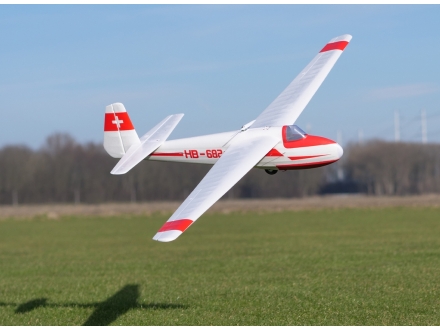
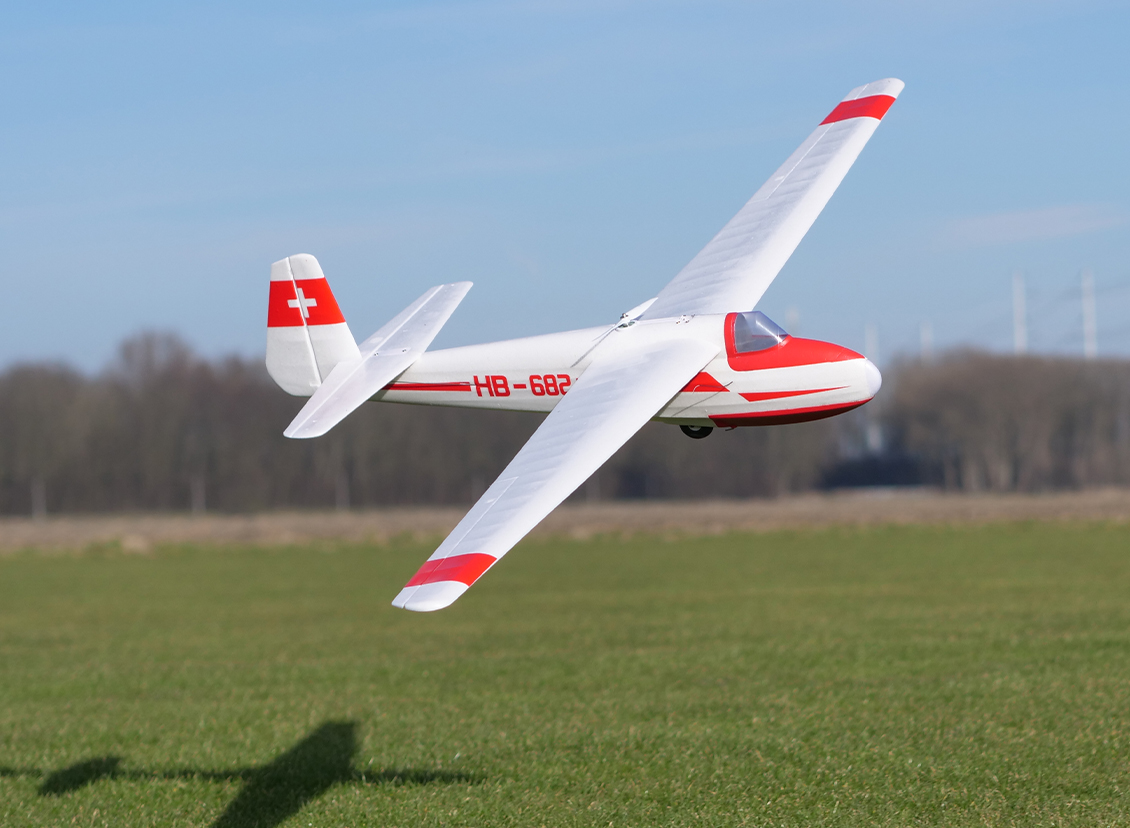
HobbyKing Hall Cherokee V2 1700mm: How the Retractable Propeller Changes the Flight
A practical look at the launch sequence, motor-off glide, V1 upgrades, battery and CG setup, tow-hook option, and the questions to answer before your first flight.
Product guide • Setup notes • First-flight advice
The Cherokee V2 is easy to misunderstand if it is described only as a 1700mm foam glider with an electric motor. Its defining feature is not simply that it has power. It is the way that power enters and then leaves the flight.
Apply throttle and the dorsal pusher arm rises into its working position, allowing the 6x4 propeller to handle the hand launch and climb. Stop the motor and the arm retracts along the fuselage, removing much of the exposed propulsion system from the airflow so the aircraft can return to its real purpose: soaring.
That makes Cherokee V2 a two-phase aircraft. The powered phase is about a safe launch and an efficient climb. The unpowered phase is about airspeed, coordinated turns and using the 1700mm wing well. This guide explains both phases, along with the setup decisions that connect them.
Cherokee V2 is best for pilots who already understand four-channel control and want a self-launching scale glider with a cleaner motor-off profile. It is not intended to behave like a self-correcting first trainer.
What Kind of RC Glider Is the Cherokee V2?
The full-size Hall Cherokee II was designed by American Stan Hall and introduced in 1956 as a practical homebuilt sailplane. Its high wing, slender fuselage and fixed central wheel gave it a distinctive, purposeful appearance rather than the highly polished shape of a modern composite glider.
HobbyKing's 1700mm version keeps that recognizable character, but V2 is designed to remove one of the biggest practical barriers to flying a scale glider: getting it to altitude. No tow pilot or permanent powered nose is required for a normal flight. The installed system provides its own launch and climb, then retracts for the soaring phase.
Think of it as a sport-scale sailplane with self-launch capability, not as a conventional power plane with an unusually long wing. The distinction matters because the most satisfying flight is not a full-throttle circuit. It is a clean climb, a deliberate power-off transition and a long period of energy management.
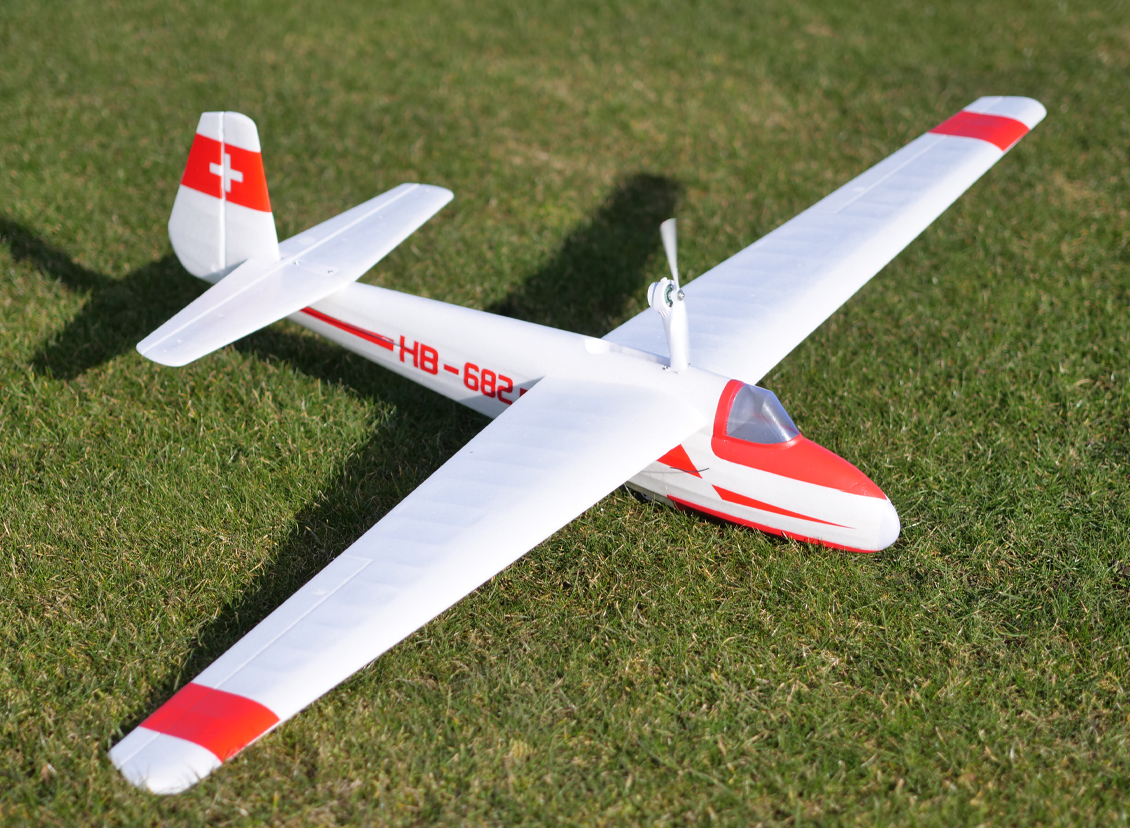
The 6x4 pusher propeller sits above the fuselage for powered flight and retracts when the motor is stopped.
How Does the Retractable Propeller Arm Work?
The V2 power system combines a 2026-2300KV brushless outrunner, a 20A ESC and a 6x4 pusher propeller. The important part is the relationship between throttle and arm position: the arm deploys for powered operation and retracts when the motor is stopped.
Does it need a separate retract channel? No separate auxiliary retract mechanism is specified for normal operation. That keeps the radio installation simpler than a system that needs an additional retract servo, controller and switch assignment.
Why put the propeller above the fuselage? A dorsal pusher keeps the nose and wing leading edge free of a conventional tractor propeller. When retracted, it also removes the large fixed EDF pod used by the original Cherokee from the airflow.
What is the practical trade-off? The launch sequence deserves attention because the propeller is close to the hand-launch area. Use throttle cut while handling the model, keep hands and loose clothing outside the propeller arc, and allow the arm to reach its powered position before release.
What Changes From Launch to Glide?
Launch and establish a climb
For a powered hand launch, the manual recommends a firm release approximately 10–20 degrees above the horizon. Build airspeed before making a significant turn. For the maiden flight, calm conditions below 5mph / 8kph provide the clearest opportunity to trim the aircraft without fighting turbulence.
Retract, settle and start soaring
The manual suggests climbing to roughly 100–150ft before reducing power and beginning gentle turns. After the motor stops and the arm retracts, let the model settle into its glide rather than forcing an immediate steep turn. Protect airspeed and make smooth, coordinated corrections.
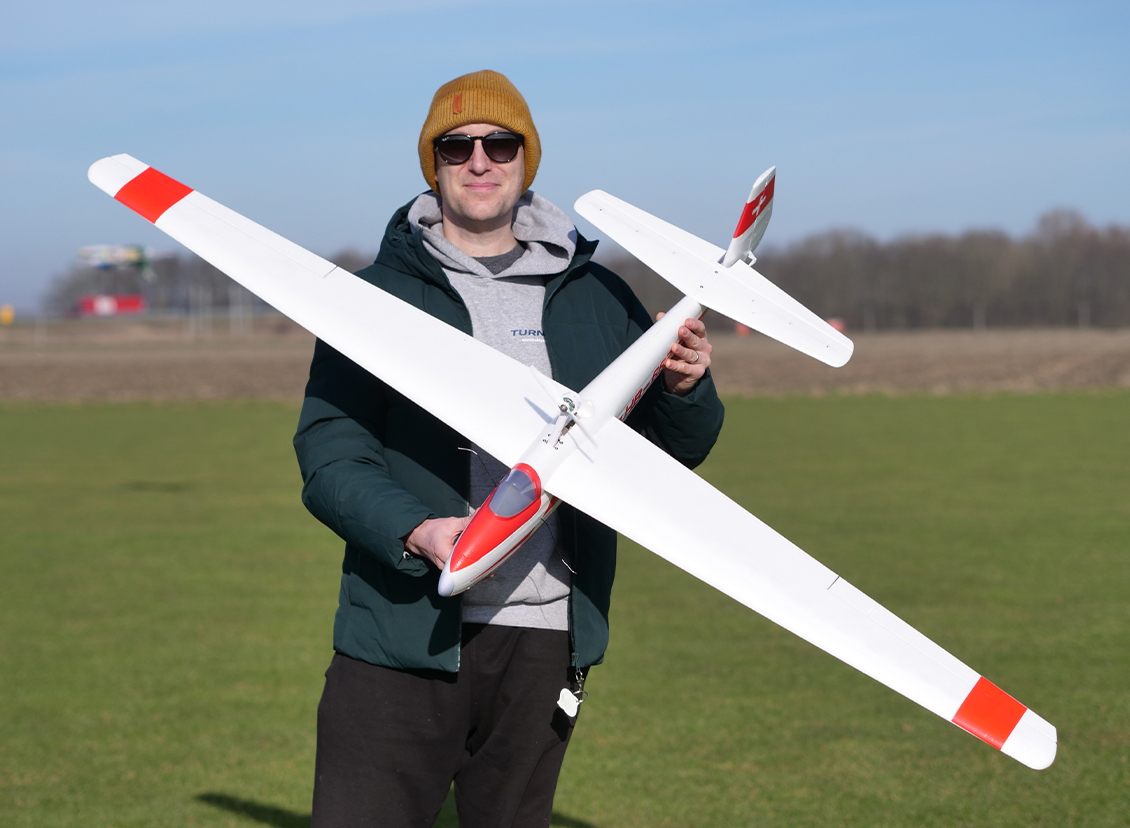
A safe launch begins before the model leaves the hand: confirm control direction, arm operation, battery security and a clear propeller arc.
V1 vs V2: More Than Replacing the EDF
The original model used a removable 64mm EDF pod. It was a clever way to give a scale glider self-launch capability, but the pod remained a relatively large object above the fuselage whenever it was installed. V2 changes the propulsion concept and also addresses two structural areas that matter during ownership: the wing connection and horizontal tail.
The V1's thinner wing structure and original fiberglass joiner arrangement were more vulnerable to handling damage and hard arrivals. V2 uses reinforced detachable wing panels secured with supplied hardware. The horizontal stabilizer is also enlarged and remains removable for transport.
| Area | Cherokee V1 | Cherokee V2 |
|---|---|---|
| Power system | Removable 64mm EDF pod | Retractable dorsal arm with 6x4 pusher propeller |
| Wing and joiner | Thinner wing with the original fiberglass joiner arrangement | Reinforced detachable panels secured with supplied hardware |
| Horizontal tail | Smaller horizontal stabilizer | Enlarged detachable horizontal stabilizer |
| Battery | 3S 1500mAh for powered flight | 3S 2200mAh 30C Shorty LiPo with XT60 |
| Powered weight | Approximately 700g | Approximately 900g |
Does the extra 200g automatically make V2 worse at soaring?
No single weight figure can answer that question. V2 carries a larger battery, reinforced structure, a larger tail and a different power system, so its approximately 900g flying weight should be understood as part of a complete redesign rather than an isolated penalty.
There is still a real trade-off: more mass means the pilot should preserve airspeed and avoid trying to make the model float at an unrealistically slow speed. In return, V2 gains structural security and a more purposeful climb system. The correct comparison is how the whole aircraft completes the launch-climb-glide cycle, not which version has the lowest number on a scale.
Battery Fit, CG and Control Throws
Why the shorty battery matters
The baseline pack is a 3S 2200mAh 30C Shorty LiPo with an XT60 connector. Capacity alone is not enough: two 2200mAh packs can have different dimensions, weight and lead positions. A short-format pack provides useful room for positioning while keeping the installation close to the intended setup. Secure the pack so it cannot move during launch, climb or landing.
Set the balance before changing the rates
The recommended center of gravity is 60–65mm behind the wing leading edge, checked with the intended flight battery installed. Begin inside that range rather than using transmitter adjustments to hide a balance problem. An aft setup can make pitch response less forgiving during launch and landing.
Manual control-throw starting points
| Control surface | Low rate | High rate |
|---|---|---|
| Aileron | 10mm | 15mm |
| Elevator | 8mm | 15mm |
| Rudder | 25mm | 40mm |
Use low rates for the first launch, verify every control direction and complete a range test. Add only moderate expo if desired; expo cannot correct excessive mechanical travel or an incorrect CG.
What Does the Tow-Hook Option Mean?
The optional underside hook gives Cherokee V2 another way to reach altitude when suitable equipment and experienced helpers are available. It may be used for towing or a compatible catapult-style launch method as shown in the manual.
The Cherokee is the aircraft being launched or towed. The feature does not mean that Cherokee V2 is intended to pull another model. For most owners, the retractable propeller provides the simplest independent launch method; the hook matters to glider clubs and pilots who already use alternative launch systems.
Do not improvise a tow or catapult setup without appropriate equipment, line release planning, field space and experienced assistance. A powered hand launch is the more direct first-flight route described for the standard electric configuration.

Once power is removed, smooth control inputs and protected airspeed matter more than aggressive maneuvering.
A First-Flight Checklist That Goes Beyond the Basics
- Inspect the retractable arm and propeller. Confirm that the arm moves freely, the 6x4 propeller is undamaged and all hardware is secure.
- Check the detachable wing and tail hardware. Verify that both reinforced wing panels, the enlarged horizontal stabilizer and every fixing are correctly seated.
- Secure the exact battery you will fly. Confirm the XT60 connection, battery restraint and 60–65mm CG with that pack installed.
- Use low rates and verify direction. Check aileron, elevator, rudder and throttle, then complete a radio range test.
- Program throttle cut. Keep the motor disarmed during setup and handling, especially while checking the dorsal arm.
- Choose the field deliberately. Use a large, obstruction-free site and aim for wind below 5mph / 8kph on the first flight.
- Plan the complete flight before launch. Identify the launch direction, initial climb path, trimming area, landing circuit and emergency motor-on recovery route.
The PNF airframe arrives with the motor, 20A ESC and four 9g servos installed. Normal final assembly uses the supplied mounting hardware; no glue is specified in the manual's standard assembly sequence.
See Cherokee V2 in the Air
The official video is useful for understanding the aircraft's visual profile, the deployed power system and the transition back to gliding. Watch the launch sequence closely before preparing your own model.
Who Will Enjoy the Cherokee V2?
A strong match for
- Pilots comfortable with four-channel aileron, elevator, rudder and throttle control.
- Powered-glider pilots who want independent hand-launch capability.
- Scale-soaring enthusiasts who value the Hall Cherokee outline.
- V1 owners interested in stronger wing construction, a larger tail and a cleaner power concept.
Think carefully if
- You need a self-correcting first airplane or depend on built-in stabilization.
- You are not yet comfortable hand launching a powered model.
- You want continuous full-throttle speed rather than climb-and-glide flying.
- You do not have a large, obstruction-free field for the first flights.
Cherokee V2 Questions, Answered
Q. Is Cherokee V2 suitable as a first RC airplane?
It is better suited to pilots with basic four-channel experience. A newer pilot should use an experienced helper for setup, launch, trimming and landing.
Q. Does the propeller arm use another receiver channel?
No separate auxiliary retract channel is specified. The arm deploys for powered operation and retracts when the motor is stopped.
Q. Which battery should I start with?
Use the recommended 3S 2200mAh 30C Shorty LiPo with XT60, secure it firmly and confirm the 60–65mm CG before flight. View the baseline battery →
Q. Does normal assembly require glue?
No glue is specified in the standard final-assembly sequence. The major removable components are secured with supplied hardware.
Q. Can it launch without using the motor?
Yes. The manual shows an optional underside hook for towing or a compatible catapult-style launch method, but these methods require suitable equipment and experience.
Q. Can I assume V1 spare parts will fit V2?
No. The wing structure, horizontal stabilizer and propulsion system changed. Confirm the model version and part number before ordering a replacement.
The Power System Is the Beginning of the Story, Not the Whole Story
Cherokee V2 makes self-launching more practical, but its real character appears after the motor stops. Reinforced detachable wings, a larger removable tail and a more deliberate climb-to-glide transition make it a meaningful development of the original 1700mm Cherokee.
Explore Cherokee V2 1700mm PNF


